

Introduction
Vocabulary Development for Kids is one of the strongest predictors of future reading success, communication skills, and academic achievement. Children who develop a rich vocabulary at an early age are more likely to understand stories, express their ideas clearly, and become confident readers.
Building vocabulary doesn’t happen overnight. Children learn new words through daily conversations, books, listening activities, and meaningful interactions with the world around them. Today, talking reading pens are becoming one of the most effective Language Learning Tools, helping children expand their vocabulary while making learning enjoyable and interactive.
Unlike traditional learning materials, talking reading pens combine audio technology with interactive books, allowing children to hear words pronounced correctly, understand their meanings, and reinforce learning through repetition. Whether used at home, in preschool classrooms, or during homeschooling, they provide consistent support for language development during the most important years of childhood.
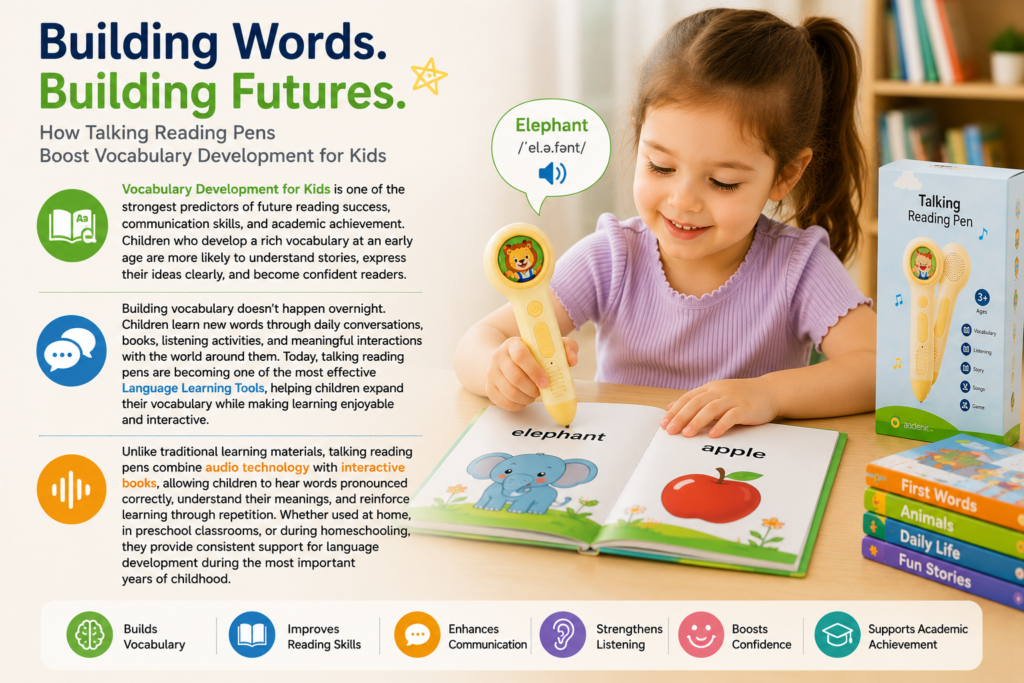
Product Overview
📷 Insert Product Image Here
Caption:
Interactive Talking Reading Pen designed to expand vocabulary, improve pronunciation, and encourage independent language learning.
Why Vocabulary Matters in Early Childhood
Vocabulary forms the foundation of literacy.
Before children learn to read independently, they first learn to understand and use spoken language.
A strong vocabulary helps children:
- Understand stories
- Express thoughts clearly
- Ask meaningful questions
- Build confidence in communication
- Learn new concepts more easily
Research shows that children with larger vocabularies generally perform better in reading, writing, and overall academic learning.
This is why Vocabulary Development for Kids should begin as early as possible.
Children’s Vocabulary Building Happens Every Day
Successful Children’s Vocabulary Building is a gradual process.
Children acquire new words through:
- Conversations with parents
- Storybooks
- Songs
- Educational games
- Classroom activities
- Interactive learning
Every new word strengthens a child’s understanding of language.
Talking reading pens accelerate this process by exposing children to thousands of words through engaging educational content.
How Talking Reading Pens Work as Language Learning Tools
Modern talking reading pens are highly effective Language Learning Tools because they combine several learning methods into one device.
Children can:
- Touch a picture
- Hear the word pronounced correctly
- Listen to explanations
- Repeat the pronunciation
- Reinforce learning through stories
This multi-sensory learning approach helps children remember vocabulary more effectively than simply looking at printed words.
Product in Action
📷 Insert Lifestyle Image Here
Caption:
Children naturally build vocabulary while interacting with books using a talking reading pen.
Strengthening Word Recognition Skills
One important part of literacy is developing Word Recognition Skills.
Children gradually learn to connect:
- Pictures
- Spoken words
- Printed words
- Meanings
Talking reading pens make this process much easier by providing immediate audio feedback.
When a child touches a picture of an elephant, for example, the pen immediately says:
“Elephant.”
The child hears the pronunciation, sees the picture, and connects both with the printed word.
Repeated exposure helps strengthen recognition over time.
Vocabulary Learning Activities Become More Interactive
Children learn best through active participation.
Talking reading pens make traditional Vocabulary Learning Activities much more engaging.
Popular activities include:
- Matching words with pictures
- Animal recognition
- Object naming
- Alphabet learning
- Daily conversation practice
- Story listening
Instead of simply memorizing words, children actively interact with educational content and receive instant responses.
This keeps learning exciting and encourages longer attention spans.
Supporting Early Language Development
Strong Early Language Development begins long before formal reading instruction.
Children first develop the ability to:
- Listen carefully
- Understand spoken language
- Respond appropriately
- Build simple sentences
- Express emotions and ideas
Talking reading pens encourage these skills by exposing children to natural spoken language through stories, conversations, and educational activities.
As children hear more language, they become more confident communicators.
Interactive Vocabulary Learning Builds Confidence
Traditional vocabulary instruction often depends on repetition alone.
Talking reading pens introduce Interactive Vocabulary Learning, allowing children to practice independently.
Interactive features may include:
- Audio pronunciation
- Picture recognition
- Question-and-answer games
- Story narration
- Vocabulary quizzes
Immediate feedback helps children correct mistakes and gain confidence without feeling pressured.
Reading and Language Skills Grow Together
Reading and speaking develop side by side.
Strong Reading and Language Skills help children:
- Understand books
- Follow classroom instruction
- Communicate confidently
- Learn new subjects
- Develop critical thinking
Talking reading pens strengthen both reading and spoken language by encouraging children to listen, repeat, and practice regularly.
The more children interact with language, the stronger their literacy foundation becomes.
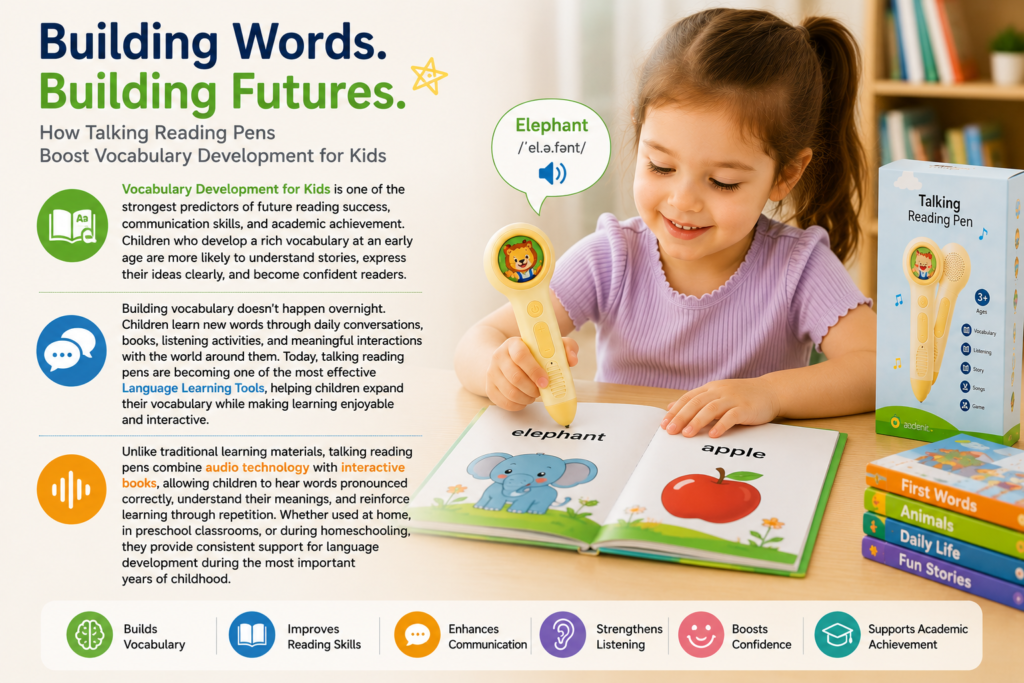
Product Feature Highlight
📷 Insert Close-up Product Image Here
Caption:
Easy-to-use controls and clear audio make vocabulary learning enjoyable for children of all ages.
Why Parents Love Talking Reading Pens
Parents appreciate reading pens because they:
- Encourage independent learning
- Reduce screen time
- Improve vocabulary naturally
- Reinforce classroom learning
- Make reading more enjoyable
Unlike passive entertainment, talking reading pens actively involve children in the learning process.
This creates positive learning habits that continue throughout childhood.
Why Teachers Recommend Interactive Vocabulary Learning
Teachers understand that vocabulary growth influences every academic subject.
Talking reading pens help educators by:
- Reinforcing new vocabulary
- Supporting pronunciation practice
- Improving listening comprehension
- Encouraging classroom participation
Because children can practice repeatedly, vocabulary retention improves significantly.
Long-Term Benefits of Vocabulary Development
Children with strong vocabularies often experience:
- Better reading comprehension
- Higher academic achievement
- Improved communication
- Greater confidence
- Stronger critical thinking
The words children learn today become the building blocks for future learning.
This is why early vocabulary development remains one of the most valuable educational investments.
Conclusion
Vocabulary Development for Kids plays a critical role in literacy, communication, and lifelong learning. Talking reading pens provide an engaging way to support Children’s Vocabulary Building through interactive books, clear pronunciation, and meaningful educational experiences.
As effective Language Learning Tools, they strengthen Word Recognition Skills, enrich Vocabulary Learning Activities, encourage Early Language Development, promote Interactive Vocabulary Learning, and improve overall Reading and Language Skills.
For parents and educators looking to help children build stronger language abilities while making learning enjoyable, a talking reading pen is an excellent educational companion that supports


