

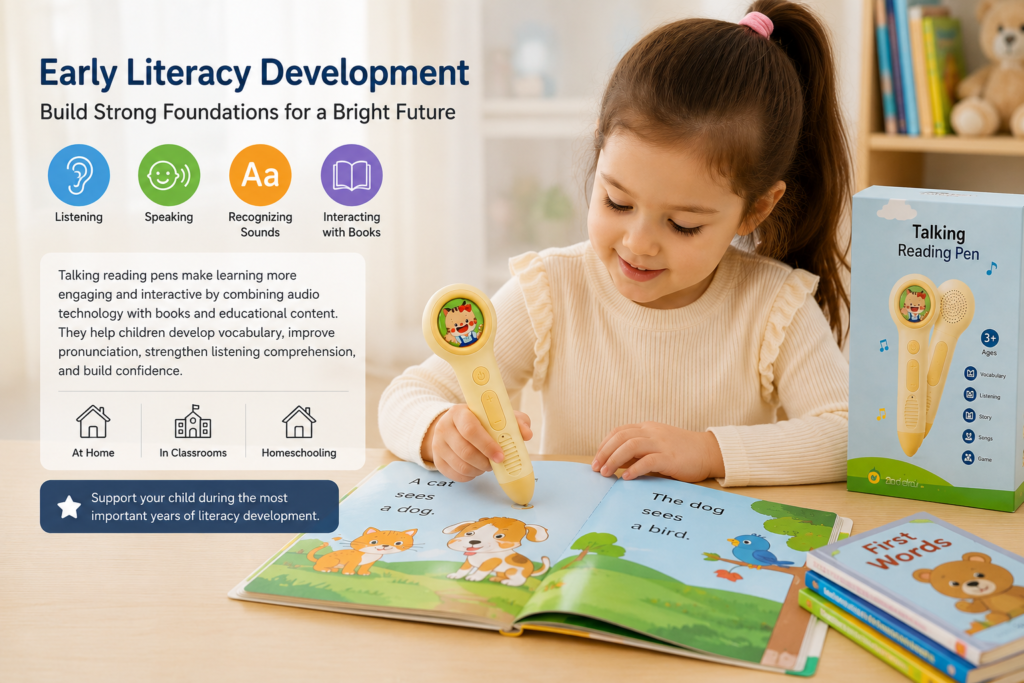
Early Literacy Development is the foundation of a child’s future success in reading, communication, and academic achievement. Long before children begin reading independently, they develop essential language skills through listening, speaking, recognizing sounds, and interacting with books. Parents and educators are increasingly using talking reading pens to make this process more engaging, interactive, and enjoyable.
Unlike traditional learning materials, talking reading pens combine audio technology with books and educational content, helping children develop vocabulary, improve pronunciation, strengthen listening comprehension, and build confidence. Whether used at home, in preschool classrooms, or during homeschooling, these devices provide valuable support for children during the most important years of literacy development.
Product Overview
📷 Insert Product Image Here
Recommended image: Your white-background product photo.
Caption:
Interactive Talking Reading Pen designed to support early literacy, vocabulary building, and independent learning.
Why Early Literacy Development Is So Important
The first few years of life are critical for brain development.
During this period, children build the foundation for future learning by developing:
- Listening skills
- Oral language
- Vocabulary
- Memory
- Attention
- Communication abilities
These early experiences directly influence reading success later in school.
Research has consistently shown that children with strong Early Literacy Development are more likely to become confident readers, better communicators, and successful lifelong learners.
Understanding Early Reading Skills
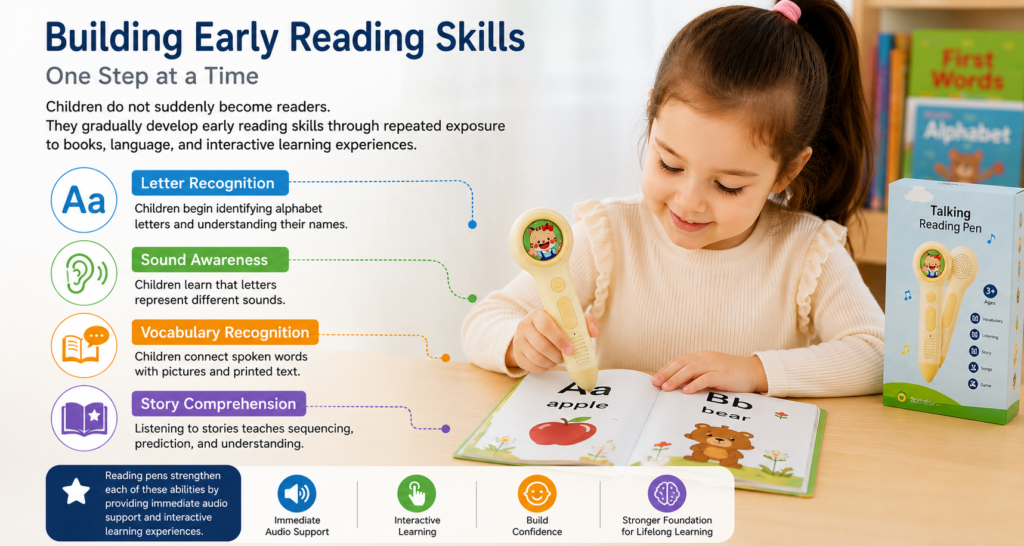
Children do not suddenly become readers.
Instead, they gradually develop Early Reading Skills through repeated exposure to books, language, and interactive learning experiences.
These skills include:
Letter Recognition
Children begin identifying alphabet letters and understanding their names.
Sound Awareness
Children learn that letters represent different sounds.
Vocabulary Recognition
Children connect spoken words with pictures and printed text.
Story Comprehension
Listening to stories teaches sequencing, prediction, and understanding.
Reading pens strengthen each of these abilities by providing immediate audio support and interactive learning experiences.
How Reading Pens Provide Literacy Learning Support
Every child learns at a different pace.
Some children need additional practice before they fully understand new words or sounds.
Talking reading pens provide valuable Literacy Learning Support by allowing children to learn independently while receiving instant feedback.
Children can simply touch a word or picture to hear:
- Correct pronunciation
- Vocabulary explanations
- Story narration
- Educational instructions
This immediate feedback helps children learn more efficiently while reducing frustration.
Product in Action
📷 Insert Lifestyle Image Here
Recommended image: A child using your talking reading pen with an illustrated learning book.
Caption:
Interactive audio learning helps children improve vocabulary and build reading confidence naturally.
Preschool Literacy Activities Become More Engaging
Preschool children learn best through play and exploration.
Reading pens make traditional Preschool Literacy Activities much more engaging by encouraging children to actively participate.
Popular activities include:
- Alphabet learning
- Animal recognition
- Vocabulary games
- Story listening
- Picture identification
Instead of simply looking at images, children interact with educational content and receive immediate responses.
This active participation keeps children interested while reinforcing learning.
Building Reading Readiness Skills Before School
Many parents believe reading begins in kindergarten.
In reality, Reading Readiness Skills begin developing years earlier.
Children need to understand:
- Book handling
- Listening carefully
- Following stories
- Recognizing sounds
- Identifying patterns
- Understanding spoken language
Talking reading pens support all of these foundational skills before formal reading instruction begins.
Children who develop strong reading readiness often transition more smoothly into elementary school.
Supporting Child Language Development Every Day
Language development and literacy are closely connected.
Strong Child Language Development allows children to understand stories, express ideas, and communicate confidently.
Reading pens encourage language growth by exposing children to:
New Vocabulary
Daily exposure increases word knowledge.
Correct Pronunciation
Children repeatedly hear accurate speech patterns.
Natural Conversations
Story narration introduces everyday language.
Listening Practice
Children strengthen comprehension through active listening.
Over time, these experiences contribute to stronger communication skills.
Beginning Reading Education Through Interactive Learning
Traditional reading instruction often relies heavily on repetition.
Reading pens make Beginning Reading Education more enjoyable by combining education with interaction.
Children can:
- Hear words spoken aloud
- Follow narrated stories
- Repeat pronunciation
- Learn independently
This interactive approach encourages children to spend more time practicing literacy skills.
Learning becomes something children enjoy rather than something they feel required to do.
Literacy Building Tools That Grow With Children
One reason parents appreciate reading pens is their long-term educational value.
Unlike many toys, reading pens serve as effective Literacy Building Tools across multiple stages of childhood.
For toddlers:
- First words
- Animal sounds
- Object recognition
For preschoolers:
- Alphabet learning
- Phonics
- Vocabulary
For elementary students:
- Reading fluency
- Story comprehension
- Independent study
This adaptability allows one learning tool to support children for several years.
Expanding Vocabulary Naturally
Vocabulary development is one of the strongest predictors of future reading success.
Children who know more words generally:
- Read more confidently
- Understand stories better
- Communicate more effectively
- Learn new concepts more easily
Reading pens expose children to new vocabulary through:
- Storybooks
- Flashcards
- Songs
- Educational activities
This repeated exposure helps children remember and use new words naturally.
Improving Phonics and Pronunciation
Understanding phonics is essential for developing Early Reading Skills.
Reading pens help children connect:
- Letters
- Sounds
- Words
- Pronunciation
Because children hear words pronounced correctly every time they interact with learning materials, they gradually develop stronger pronunciation and decoding abilities.
This consistent practice supports independent reading later on.
Encouraging Independent Learning
One of the greatest advantages of reading pens is that children can learn independently.
Instead of waiting for parents or teachers to explain unfamiliar words, children receive immediate assistance.
This independence helps children:
- Build confidence
- Practice regularly
- Develop curiosity
- Enjoy learning
These habits often continue throughout their educational journey.
Product Feature Highlight
📷 Insert Product Close-up Here
Recommended image: Close-up of your talking reading pen highlighting buttons and ergonomic design.
Caption:
Designed for small hands, easy operation, and interactive learning throughout early childhood.
Why Parents and Teachers Recommend Talking Reading Pens
Parents appreciate reading pens because they:
- Reduce screen time
- Encourage reading
- Improve vocabulary
- Promote independent learning
Teachers value them because they:
- Reinforce classroom instruction
- Support struggling readers
- Increase classroom engagement
- Improve literacy outcomes
This combination of home and classroom benefits explains why reading pens continue growing in popularity worldwide.
Long-Term Benefits of Early Literacy Development
Children who experience strong Early Literacy Development often enjoy lasting educational advantages.
These include:
- Better reading comprehension
- Higher academic achievement
- Stronger communication skills
- Greater confidence
- Improved problem-solving abilities
The literacy skills developed during early childhood influence success far beyond elementary school.
Conclusion
Early Literacy Development is one of the most valuable investments parents and educators can make in a child’s future. Talking reading pens help children build strong Early Reading Skills, provide effective Literacy Learning Support, and make Preschool Literacy Activities more interactive and enjoyable.
By strengthening Reading Readiness Skills, encouraging Child Language Development, supporting Beginning Reading Education, and serving as long-lasting Literacy Building Tools, reading pens help children become confident, curious, and capable learners.
For families seeking an engaging way to encourage early reading and lifelong learning, a talking reading pen is an excellent educational companion that grows alongside the child.


